Description
Pyramid Solitaire is a quick, satisfying card game built around making pairs that add up to 13. It offers a different kind of solitaire challenge from Klondike or Spider, with simple rules but plenty of decisions as you work your way through the pyramid. Play free online with no download whenever you fancy a relaxed game.## How to Play
### 1. Understand the layout
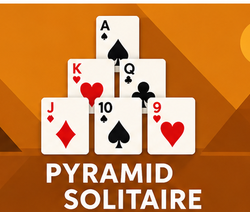
The game begins with 28 cards arranged in a seven-row pyramid. The first row has one card, the second has two, and each row increases by one card until the seventh row has seven.
Each card is overlapped by two cards in the row directly below it.
### 2. Play exposed cards
You can only use an exposed pyramid card. A card becomes exposed when there are no cards resting on top of it.
Removing cards from the lower rows gradually uncovers more of the pyramid and creates new pairing opportunities.
### 3. Make pairs that total 13
Remove two exposed cards when their combined values equal 13. Card values are:
* Ace = 1
* Cards 2–10 = face value
* Jack = 11
* Queen = 12
For example, an Ace pairs with a Queen, a 2 pairs with a Jack, and a 5 pairs with an 8.
### 4. Remove Kings on their own
Kings are worth 13, so an exposed King can be removed immediately without another card. The same applies when a King appears on top of the waste pile.
### 5. Use the stock and waste pile
Draw one card at a time from the stock. Each drawn card is placed face-up on the waste pile.
The top waste card can be paired with any exposed pyramid card if their values add up to 13. Only the top card of the waste pile is available to play.
### 6. Use your redeals carefully
When the stock is empty, you can redeal the waste pile back into the stock up to two times. This gives you three total passes through the deck.
### 7. Clear the pyramid to win
You win by removing all 28 cards from the pyramid. The game ends if no valid pair or King remains available and there are no draws or redeals left.
## Tips to Get Started
* Remove exposed Kings early. They do not need a partner and may uncover useful cards beneath them.
* Scan the whole pyramid before drawing. One pair can expose another and start a useful chain.
* Think about which card a move will uncover, especially when two different pairs are available.
* Save your redeals for genuine opportunities. Avoid using them too quickly just because the current waste card cannot be played.
In Pyramid Solitaire, the cards are arranged in a pyramid shape with a goal of removing pairs of cards that sum to 13. The game is won when all cards are cleared from the pyramid.
In contrast, Regular Solitaire involves building up four foundation piles, starting with an Ace and stacking cards in ascending order by suit. Cards are moved between tableau piles following specific rules, and the game is won when all cards are placed in the foundation piles.
While both games require strategy and focus, Pyramid Solitaire emphasizes pairing and card removal, while Regular Solitaire focuses on sorting and stacking cards in sequence.
Instructions
## Pyramid Solitaire Strategy Tips### Expose and remove Kings early
Kings cannot form pairs, so their only useful move is to be removed once exposed. When choosing between possible pairs, favour moves that uncover a buried King and clear it before it continues blocking the cards above.
### Look for moves that create a chain
Before drawing from the stock, check what sits underneath each available pair. The best move may uncover another pair immediately, allowing you to clear several cards without using another stock card or moving closer to a redeal.
### Do not always take the first available pair
A legal move is not automatically the best move. If two cards can be paired in different ways, consider which choice exposes the most useful cards or preserves a partner you may need later.
### Track Queens, Aces, Jacks and 2s
Queens can only pair with Aces, while Jacks can only pair with 2s. Keep an eye on how many of these narrow-partner cards remain visible or buried, and avoid spending an Ace or 2 when another pairing choice would preserve it for a harder-to-match card.
An Ace always counts as 1 in this version. It does not have a second value.
### Use the first two stock passes to learn the order
The waste pile can be redealt only twice, giving you three total passes through the stock. Pay attention to the order of useful cards during the earlier passes so you can plan which pyramid cards to expose before those stock cards appear again.
### Treat the final pass as your last opportunity
Once you begin the third pass, every skipped stock card is effectively gone when it leaves the top of the waste pile. Slow down, check the exposed pyramid before every draw, and avoid passing a playable card unless doing so clearly creates a stronger move.
FAQs ## Pyramid Solitaire
### Can every Pyramid Solitaire game be won?
No, many Pyramid deals cannot be cleared even with perfect decisions. The order of the stock is fixed, and crucial cards may remain unavailable behind other cards or in an unusable sequence. Its relatively low win rate means an unsuccessful game is not necessarily evidence that you overlooked a valid move.
### Can I pair two cards from the waste pile together?
No, every pair must contain at least one exposed pyramid card. Only the top waste card is available, and it may be combined with a playable card in the pyramid. You cannot use two waste cards together or search deeper into the waste pile for a matching value.
### Why do pairs have to total 13?
Thirteen matches the value assigned to the King, the highest rank. Using that target gives every other rank a complementary partner while allowing a King to clear by itself. For example, a Queen can pair with an Ace and a Jack with a 2, covering the complete range of card values.
### Do I have to empty the stock to win?
No, clearing all the cards from the pyramid is enough. The game ends in a win as soon as the 28-card tableau has been removed, even if unused cards remain in the stock or waste. Those extra cards are resources for reaching the objective rather than part of the objective itself.
### How is Pyramid different from TriPeaks Solitaire?
Both use 28-card tableaus, but their card-removal systems are different. Pyramid removes pairs whose values total 13, while TriPeaks plays exposed cards onto the waste in a one-rank sequence. Pyramid also permits two redeals, whereas TriPeaks provides only one pass through its stock.