Description
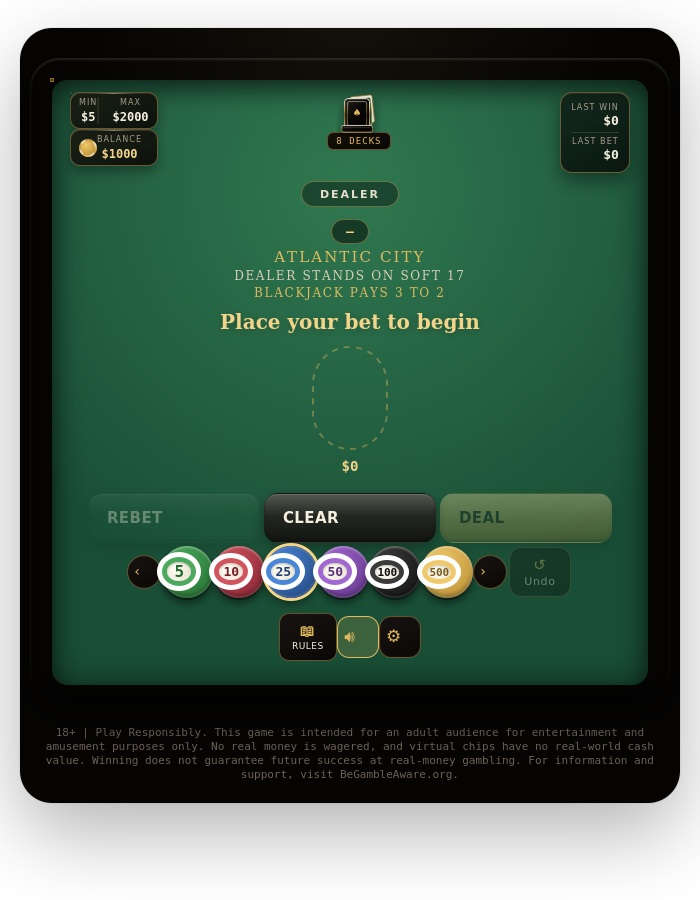
Atlantic City Blackjack follows a player-friendly ruleset shaped by the regulations used at New Jersey casino tables. If you already know Classic Vegas Strip Blackjack, much of the game will feel familiar. A natural blackjack pays 3:2, and the dealer stands on every 17, including a soft 17 containing an Ace counted as 11.
The main structural difference is the shoe. Atlantic City Blackjack uses eight decks rather than the six normally associated with Classic Vegas Strip rules. This slightly changes the card distribution, but it does not require a completely different approach to basic strategy.
The genuinely distinctive feature is late surrender. This allows you to give up your hand after the dealer has checked for blackjack. You lose half of your original bet and recover the other half instead of playing out a particularly weak hand. For example, surrendering can be the better choice when your cards are very unlikely to beat a dealer showing a strong upcard. It may feel strange to accept a partial loss, but losing half a bet can be preferable to risking the entire amount. Late surrender is a regulatory requirement at Atlantic City blackjack tables.
You can double down on any first two cards, including after splitting. Pairs may be split to create up to four hands, although Aces cannot be re-split. When Aces are split, each new hand receives only one additional card.
If you are dealt blackjack while the dealer shows an Ace, you will be offered even money. Accepting it guarantees an even-money win before the dealer’s hidden card is revealed, although declining it preserves the full 3:2 payout when the dealer does not also have blackjack.
You can play Atlantic City Blackjack free online directly in your browser, with no download required. The game uses the full Atlantic City ruleset, giving you a practical way to learn when to split, double or surrender without risking real money.
Instructions
Atlantic City Blackjack uses the familiar aim of beating the dealer without taking your hand over 21. Most of its rules will feel conventional, but the eight-deck shoe, splitting restrictions and availability of late surrender affect several important decisions.### The Eight-Deck Shoe and Soft 17
Atlantic City Blackjack is dealt from an eight-deck shoe. The dealer stands on every total of 17, including a soft 17. A soft 17 is a hand totalling 17 with an Ace counted as 11, such as Ace-6.
Standing on soft 17 is slightly better for the player than a rule requiring the dealer to hit it. The dealer cannot draw again to improve the hand, although you must still follow basic strategy rather than assuming that every total below 17 should be hit.
### Blackjack Pays 3:2
A natural blackjack, made with an Ace and a ten-value card as your first two cards, pays 3:2. A £10 bet therefore wins £15, provided the dealer does not also have blackjack.
This full payout matters because some blackjack games pay only 6:5. The difference may look small on one hand, but accepting 6:5 substantially increases the house advantage over time.
### Doubling Down
You may double down on any first two cards. Doubling is also allowed after splitting a pair, so a strong two-card hand created by a split can still receive an increased wager.
This flexibility lets you commit more money when your hand is in a favourable position against the dealer’s upcard. You receive exactly one additional card after doubling, so the option should be used when the potential reward outweighs the risk of being unable to hit again.
### Splitting Pairs
Repeated splits can create up to four separate hands. Each hand receives its own wager and is played against the dealer independently.
Split Aces receive special treatment. Each Ace is dealt exactly one additional card, and the Aces cannot be split again if another Ace appears. This is a deliberate rule, not a game error. Some blackjack rooms permit Aces to be re-split, but Atlantic City rules impose this restriction because starting a hand with an Ace is particularly valuable.
The one-card limit also means that an Ace paired with a ten-value card after a split is normally treated as 21 rather than a natural blackjack, so it does not receive the 3:2 payout.
### Late Surrender
Late surrender allows you to give up your hand after seeing your first two cards and the dealer’s upcard, once the dealer has checked that they do not have blackjack. You immediately forfeit the hand, lose half your original bet and recover the other half.
Surrender is useful when your hand has such a poor chance of winning that losing half the bet is preferable to playing for the full amount. A hard 16 against a dealer 9, 10 or Ace is the type of difficult situation in which surrender may be considered, although the correct decision can depend on the precise cards and upcard.
### Even Money
When you have a natural blackjack and the dealer shows an Ace, you may take even money. This locks in a guaranteed 1:1 profit immediately instead of waiting to learn whether the dealer also has blackjack, which would make the hand a push.
Even money removes the risk of winning nothing, but it also gives up the opportunity to receive the full 3:2 payout when the dealer does not have blackjack. It is essentially an insurance decision, and basic strategy generally favours declining it.
Most Atlantic City rules resemble those used in Vegas Strip Blackjack. Late surrender is the important exception: it gives you a way to limit the damage from a very weak starting hand that standard Vegas Strip rules do not provide.