Description
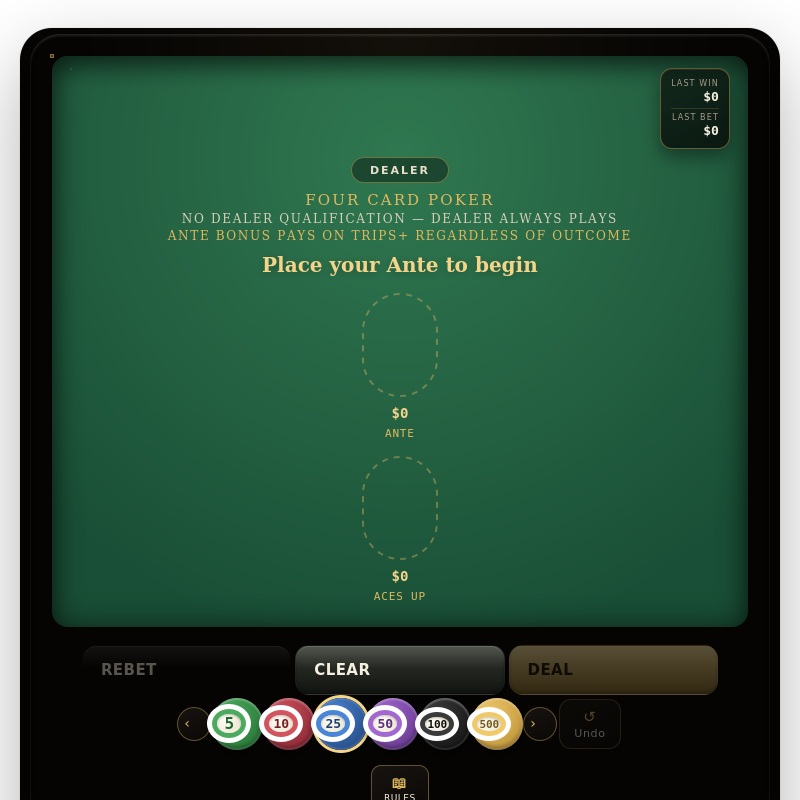
Four Card Poker is a fast casino table game built around familiar poker hand rankings, but the way each hand develops gives it a character of its own. Rather than trying to make a five-card hand, you receive five cards and play only the strongest four-card combination. The remaining card is discarded automatically, so your decision is based on the best four cards available to you.The dealer receives six cards, giving the house an extra opportunity to form a strong four-card hand. One dealer card is shown face-up before you act, providing a small but useful piece of information. Unlike several other poker-based table games, the dealer does not need to qualify with a minimum hand. Every dealer hand plays, regardless of its strength, and ties are awarded to the player.
The central decision is whether to fold or raise. After seeing your cards and the dealer’s exposed card, you can raise by one, two or three times your original Ante. This variable raise is one of the game’s defining features. A promising hand can support a larger commitment, while a marginal holding may justify a smaller raise or a fold. It creates a wider range of decisions than games that offer only one fixed play bet.
Four Card Poker should appeal to players who understand basic poker rankings but prefer a quick game without bluffing, shared community cards or several betting rounds. Each result is settled directly against the dealer, keeping the pace straightforward while leaving room for judgement over raise size.
An optional Aces Up side bet is also available. It is evaluated solely on the strength of your own four-card hand, independently of the dealer’s cards and the result of the main wager.
You can play Four Card Poker free online in your browser, with no download or signup required. It is a convenient way to learn how the discard, exposed dealer card and flexible raising system work before deciding how aggressively to play each hand.
Instructions
## How to Play Four Card PokerFour Card Poker uses familiar poker hands but changes the number of cards, hand rankings and betting decisions. You play directly against the dealer, with the aim of making the stronger four-card hand.
### Place Your Ante and Optional Aces Up Bet
Every round begins with a required Ante bet. You can also place an optional Aces Up side bet, which is settled according to the strength of your own hand rather than whether you beat the dealer.
### Receive Five Cards and Keep the Best Four
You are dealt five cards, but only four are used to form your final hand. The game automatically selects your strongest possible four-card combination and discards the remaining card, so you do not need to choose which card to remove.
### Use the Dealer’s Face-Up Card
The dealer receives six cards and uses the best four to make their final hand. Exactly one dealer card is shown face-up before you make your betting decision. This is real, usable information that can help you judge how likely the dealer is to form a strong hand.
### Fold or Raise
After seeing your hand and the dealer’s exposed card, you must either fold or raise. Folding ends the round and forfeits your Ante. Raising means placing an additional bet worth one, two or three times your Ante.
The size of the raise reflects your confidence in the hand. A larger raise is not compulsory with any particular combination, although stronger hands generally justify risking more.
### The Dealer Always Plays
There is no dealer qualification requirement. Unlike many similar poker-based games, the dealer’s hand always counts, even when it contains only weak cards.
### Four Card Poker Hand Rankings
Hands rank from lowest to highest as follows:
High Card, Pair, Two Pair, Straight, Flush, Three of a Kind, Straight Flush and Four of a Kind.
Three of a Kind beats a Flush in Four Card Poker, which is the reverse of standard five-card poker. This is because making a four-card Flush is mathematically more common than making Three of a Kind, so the Flush receives the lower ranking.
### Ties Go to the Player
If your four-card hand and the dealer’s hand are exactly equal, you win the comparison. The result is not treated as a push.
### Ante Bonus
The Ante Bonus pays whenever your final hand contains Three of a Kind or better. This bonus is awarded regardless of whether your hand ultimately wins or loses against the dealer.
For a straightforward basic strategy, raise three times your Ante with a pair of tens or better. Raise once with a pair of twos through nines, and fold anything weaker.