Description
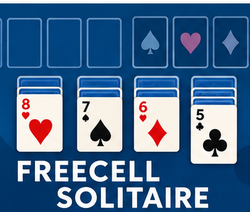
FreeCell Solitaire takes the familiar foundations and alternating-colour sequences of classic solitaire and turns them into a game of open information. All 52 cards are dealt face-up before you make your first move, spread across eight tableau columns. Unlike Klondike or Spider, there are no hidden cards to uncover and no surprises waiting beneath the tableau. You can see the whole puzzle from the beginning.That makes FreeCell a game of logic and planning rather than one that depends heavily on luck. Nearly every deal can be won with correct play, but having all the information does not make the solution obvious. Each move changes which cards are accessible and how much space remains for rearranging the tableau. Success comes from thinking several moves ahead rather than simply moving every available card.
The four free cells give the game its name. Each one can temporarily hold a single card, allowing you to move an obstructing card aside while you reach something underneath it or rebuild a sequence elsewhere. They are useful, but filling them too quickly can leave you with very little room to work. An empty tableau column is even more powerful because any card can be moved there, with no King-only restriction.
Cards on the tableau are built downward by alternating colour, following the same rule as Klondike. The aim is to move the entire deck onto four interactive foundations, building each suit from Ace through to King. The challenge lies in deciding which cards to move, what space to preserve and when it is safe to send cards to the foundations.
You can play FreeCell Solitaire free online in your browser with no download required. Every card is visible and every move is yours, making each deal a clear test of patience, organisation and forward planning.
Instructions
FreeCell Solitaire uses the same familiar card-building principles as Klondike, but it plays more like a puzzle than a game of chance. With every card visible from the beginning, success depends on planning moves carefully, managing the available space and avoiding decisions that block important cards.### The Deal
FreeCell is played with a standard 52-card deck dealt into eight tableau columns. The first four columns contain seven cards each, while the remaining four contain six cards each. Every card is dealt face-up immediately.
This complete visibility is what makes FreeCell different from many other solitaire games. There are no hidden cards waiting to help or hinder you later, so almost nothing depends on luck after the deal. You can study the entire layout from move one, identify trapped Aces and low cards, and plan how to reach them before making your first move.
### Building the Tableau
Cards are arranged on the tableau in descending rank and alternating colours, just as they are in Klondike Solitaire. For example, you can place a red 6 on a black 7, followed by a black 5 on that red 6.
Building sequences creates access to covered cards deeper in each column. However, a move that looks useful immediately can block another card you need later, so check where both cards of the required colour are located before extending a sequence.
### Using the Four Free Cells
The four free cells appear above the tableau, and each cell can hold exactly one card. Any available card can be placed in an empty free cell temporarily, then moved back to the tableau or directly to a foundation whenever a legal move becomes available.
Free cells help you move inconvenient cards out of the way, but they are limited working space rather than permanent storage. Filling all four too early can leave you unable to rearrange sequences or uncover important cards.
### Filling Empty Columns
When a tableau column becomes empty, you may move any single card into it. Unlike Klondike, there is no rule requiring the new card to be a King. A valid movable sequence can also be placed there when enough temporary space is available.
Empty columns are especially valuable because they provide much more flexibility than individual free cells. Creating one can make it possible to reorganise a long sequence and reach cards that previously appeared trapped.
### Building the Foundations
The four foundations are built by suit from Ace through to King, following the same rule as Klondike. Start with an Ace, then add the 2, 3 and remaining cards of that suit in ascending order.
Moving low cards to the foundations clears space, but avoid sending a card up automatically if it is still needed to support a useful tableau sequence. A safe foundation move should improve the layout without removing a card required elsewhere.
### Understanding the Supermove
Many FreeCell games allow you to drag several correctly arranged cards together. This “supermove” is really shorthand for moving those cards individually through available free cells and empty columns.
The number of cards you can move together therefore depends on how much open space you currently have. More empty free cells increase your capacity, while empty tableau columns increase it much more dramatically. As those spaces are filled, the size of the sequence you can move becomes smaller.
For a strong basic strategy, do not fill free cells early unless you have a clear way to empty them again. Whenever possible, prioritise creating an empty tableau column over preserving every free cell, because one empty column provides far more moving power and can completely open up a difficult deal.
FAQs ## FreeCell Solitaire
### How many cards can I move at once?
Your capacity equals the number of empty free cells plus one, doubled for each empty tableau column. With all four cells open and no empty column, you can move five arranged cards. Adding one empty column doubles that capacity to ten, showing why open columns are especially valuable.
### Is there such a thing as an unwinnable FreeCell deal?
Yes, although unwinnable deals are exceptionally rare. Among the first 32,000 numbered Microsoft FreeCell deals, only one is known to be unsolvable. It is therefore safer to say that nearly every deal can be won rather than claiming that every possible arrangement has a solution.
### Why is it called FreeCell?
The name comes from the four free cells above the tableau. “Free” means open working space rather than cards that carry no restriction. Each cell can temporarily hold one card, giving you room to rearrange the tableau and release cards that would otherwise remain blocked.
### Do the free cells need to be empty to win?
No, the cells do not have to be cleared as a separate objective. You win when all 52 cards reach the foundations. A card sitting in a free cell can simply move from there to its appropriate foundation when the required lower cards have already been placed.
### Why is FreeCell more about skill than Klondike?
Every FreeCell card is visible from the beginning, so you can plan around the complete layout. Klondike conceals much of the deck and reveals information gradually, making its outcome more dependent on the shuffle. FreeCell still includes rare unwinnable deals, but your decisions usually determine whether a solvable layout is completed.